Press Release | Total Care Podiatry - Part 2

High Heel Shoe Wearers Have Shorter Achilles Tendons

Submitted by Denise Reynolds RD on 2010-07-19

If you habitually wear high heels during the week, you may have found that switching to flats for the weekend results in calf and heel pain. Researchers have found that wearing high heels can cause changes to occur in the length of the calf muscle fibers and the Achilles’ tendons that increases the risk of stiffness and pain.

Professor Marco Narici of the Manchester Metropolitan University recruited a group of 11 heel wearing volunteers (two inches or higher for five days a week or an average of 60 hours a week) and 9 non-heel wearers to study their feet and legs with MRI and ultrasound. The women ranged in age from 20 to 50 years old, with an average age of 43.

While the MRI did not reveal any difference in the size of the calf muscles between the two groups, an ultrasound found the length of the muscle fibers to be 13% shorter in those who regularly wore high heeled shoes. The women who wore high heels also had 22% thicker Achilles’ tendons, which attaches the calf muscle to the heel.

Wearing heels cause the foot to point down more than normal. Changing this angle, such as when women switch to flats, causes the calf muscles and tendons to lengthen, increasing tension, reducing the ankle’s active range of motion, and causing discomfort and pain. Shorter tendons and muscle fibers also impacts a woman’s ability to walk fast and run and may increase risk of injury.

Brendon Brown, president of the Australasian Podiatry Council, suggests that women who consistently wear high heels should give themselves a break. “Don’t wear high heels to and from the train station, for example. Strap into a lower pair of heels,” he says.

Also, high-heel wearing women should also perform stretching exercises to prevent the fascicle fibers and Achilles’ fibers from shortening. Dr. Carol Ewing Garber, PhD and exercise physiologist at Columbia University, suggests the following:

• While sitting, loop a resistance band around the top of your foot (a belt or towel works too). Gently pull back on the band while pushing against it with your toes.
• Stand on a step, facing up. Keep your toes on the step and slowly lower your heels until you feel your calf muscles stretching.
• Slowly make a circle with your toes, alternately flexing and pointing your foot.
• Try to pick things up with your toes. (This will help strengthen your feet.)

Back to Top

Gait analysis uses technology to help patients overcome injuries

Published: Wednesday, June 23, 2010, 12:00 AM     Updated: Wednesday, June 23, 2010, 5:20 PM
gait.jpg
SEAN SIMMERS, The Patriot-NewsMark McDonald, clinic director of First Choice Rehabilitation in Lower Paxton Twp., uses a computer to analyze how a patient walks or runs. Censors in the shoes send some 1,000 points of information — about foot pressure, timing, range of motion, strength and foot asymmetry — to the computer and creates diagrams that aid in the creation of a treatment plan.
For a while, Stephen Moniak tried to ignore it, but finally, the recurring pain in his left foot drove him to the doctor. The physician, in turn, referred him to a physical therapist.

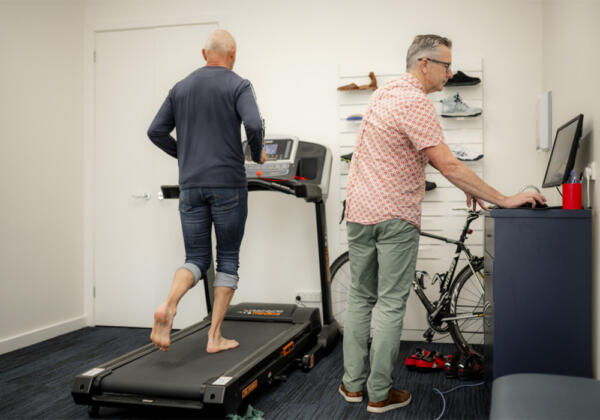
Mark McDonald, clinic director of First Choice Rehabilitation in Lower Paxton Twp., relied on more than observational skills to diagnose Moniak’s problem. He used a computer.

In computerized gait analysis, the patient walks or runs with sensors in his or her shoes. The sensors send some 1,000 points of information — about foot pressure, timing, range of motion, strength and foot asymmetry — to the computer and creates diagrams. The therapist and patient can then review them and come up with a treatment plan.

On the computer screen, different colors represent different amounts of pressure. Gait analysis might indicate, for example, that a person puts more pressure on one foot than the other — favoring one because the other hurts.

Whatever the cause, computerized gait analysis can document issues a physical therapist might not see easily — such as leg-length discrepancy or changes in the way the feet hit the ground on each step. The computer can also show patients’ steps in slow motion.

Moniak was diagnosed with plantar fasciitis — a condition partly related to being a runner. When a person strains the ligament connecting the heel bone to the toes, the band becomes weak, swollen or irritated and causes pain to the heel or bottom of the foot.

“It’s pretty nifty to see the problem you’re experiencing firsthand” on the computer, said Moniak, 37, an attorney with Rhoads and Sinon.

McDonald sees patients of all ages, athletic and not. These include children with an “awkward gait” — possibly from developmental delays or structural problems.

Some patients come in with obvious injuries; others complain of chronic pain. Pain means there’s some sort of injury, McDonald pointed out, even if it’s not a broken bone or torn ligament. It could be irritation of the soft tissue; people tend to lose flexibility there with age. Repeated stresses to an area might lead to microtearing at the cellular level. Other patients might have pain because of a structural problem — such as knock-knees. If there is a deformity, physical therapy helps support or accommodate it, perhaps with a brace or orthotic.

Regardless of the source, relearning normal gait is an important goal.

“As you walk, certain things should happen in your muscles and joints, and in the timing,” the therapist said. “If you have pain, you’re not walking with a proper pattern.”

Mike McCormick, who also runs, is back at First Choice Rehabilitation for the second time in three years. Earlier, he was treated for a knee problem — patella-femoral syndrome. More recently the 45-year-old was experiencing pain in his feet, which McDonald diagnosed plantar fasciitis, attributable to “biomechanical improper use.”

Both times the physical therapist used computerized gait analysis. It’s only one “tool” of the physical therapist, but a valuable one, McDonald said.

“It also gives me, the patient, direct feedback, so we can go about fixing the problem,” said McCormick, a developer of senior communities.

McDonald has been using computerized gait analysis for about 15 years. He said the technology can be expensive, and therapists have to invest time to learn to interpret the system. But for him, it’s been worth it, McDonald added.

For one thing, computerized gait analysis lends credibility. “Sometimes, if I tell a patient he or she isn’t walking right, the patient will look at me as if I have two heads,” the therapist said. But with a computerized picture, the message sinks in quickly. “The computer shows patients what’s ‘normal’ and what’s not. It’s patient instructional education.”

The analysis also documents improvement.

“With the use of the technology, we can evaluate if what we’ve been doing is effective, if it’s doing what we want it to to improve the patient’s functioning,” McDonald said.

Thanks to orthotics in his shoes and flexibility exercises, McCormick is getting better.

Exercise is also working for Moniak. “With the studies from six months ago and the studies now, we can see how I’m improving,” he said.


Please note :  Total Care Podiatry has this technology for its patients.

Back to Top

Diabetes Isn’t Caused By A Sweet Tooth – But Nearly Half Of People Think It Is

Article Date: 15 Jun 2010 – 0:00 PDT

Nearly half (42 per cent) of people still think eating too much sugar causes diabetes and a quarter (25 per cent) of people object to people with diabetes injecting insulin in public, according to a survey by Diabetes UK.

Diabetes UK is concerned that findings from our Diabetes Myths survey, which questioned 2,032 people, show that some beliefs are still worryingly widespread. We want to kick start Diabetes Week (13 – 19 June) by raising awareness of diabetes and dispelling the myths that still surround the condition.

Simon O’Neill, Director of Care, Information and Advocacy Services at Diabetes UK, explains: “These sorts of myths are not helpful and can lead to discrimination and bullying. Sadly, we often hear of children who are bullied at school because their peers believe they’ve brought their diabetes on themselves from eating too many sweets. People with diabetes have a hard enough time living with their condition without being made to feel ashamed or different from their peers.”

Fact over fiction

Diabetes is caused by a combination of genetic and environmental factors. Sugar does not cause diabetes. However, eating a diet high in sugar can cause people to become overweight which increases the risk of developing Type 2 diabetes.

O’Neill continues: “Diabetes UK is appalled that some people object to injecting in public. For people who treat their diabetes with insulin, this is not a choice – insulin keeps them alive and injections have to be administered at specific times. People should be able to inject in public without fear of being mocked or shunned by those around them.”

The survey also discovered that 50 per cent of people think that people with diabetes benefit from food and drink labelled “suitable for diabetics”.

The truth about diabetes

O’Neill explains: “Diabetic foods have no extra nutritional value and are more expensive. Diabetes UK advises that people with diabetes have the same healthy, balanced diet (that is low in fat, sugar and salt) as people without the condition. We are calling for an end to the use of the terms ‘diabetic foods’ and ‘suitable for diabetics’ on food labels altogether.

“Diabetes UK is hoping to destroy these myths by shedding light on them and replacing them with the truth – it is vital that people with and without diabetes have accurate information about the condition.”

Other diabetes myths include:

- Type 2 diabetes is mild diabetes
- If you have diabetes you can’t drive
- People with diabetes can’t play sport

Source
Diabetes UK

Back to Top

Summer heat and your feet!

It is quite a challenge to keep your feet cool when walking around in extremely hot weather. Therefore, your feet need some special care and attention during the summer months. Heat and humidity will aid in the growth of bacteria, so taking measures to reduce these will help enormously.

During the summer, foot injuries are also more prevalent – the increased level of outdoor athletic activities also increase the chances of muscle pain, heel pain, shin splints, plantar fasciitis, Morton’s neuroma, achilles tendinitis, hip pain/bursitis, runner’s knee, illiotibial band syndrome(ITB) and the list goes on…….

How do we deal with summer heat and our feet?

Moisture Management:

The most important thing is to manage moisture in order to decrease the risk of athlete’s foot and pronounced foot odour. Excessive perspiration has been seen as a significant contributor to these conditions. In technical terms, this excessive perspiration is known as hyperridrosis-a rapid production of sweat that cannot be evaporated as fast as it is produced. When this happens, the shoe’s material becomes saturated with moisture. In the perspiration there is also bacterial waste. You may ask what is this bacterial waste? Perspiration is body “waste” and has an abundance of bacteria. In addition, it is believed that approximately 98 per cent of this perspiration is moisture and 2 per cent is solids – mostly acids and salts. These bacteria thrive on moisture, warmth and darkness – just like the bacteria that causes toe fungus.

Solutions:

In terms of cleanliness and hygiene habits, wash your feet daily and dry thoroughly before putting on footwear. Always, use a clean pair of socks, preferably, specially-designed cotton or synthetic perspiration wicking fabric to get rid of foot odour. For example, ‘Thorlos’ and ‘Balega’ brand of cushioned socks are especially designed to provide insulation and air flow and wicks away moisture and keep your foot from getting too hot. Refrain from wearing yesterday’s gym socks just because they smell clean. One wear is enough to leave behind sufficient foot perspiration for odour-causing bacteria to thrive on. It will be enough to leave feet stinky and dirty. Footwear is another important factor. When selecting shoes it is important to avoid shoes or boots with non-breathable upper materials, especially closed-type shoes or simply tight-fitting shoes. For example, leather with its unique internal structure of fibers and inter-fiber air spaces, plus its surface pores, has excellent breathing capacity.

2. Foot Pain and injury:

To alleviate such pain and avoid further injury, consider custom orthotics or inserts with proper arch support for your foot type. Such items can be purchased at specialty footwear stores or pedorthic facilities. If you want to continue running, walking or remain active for many more years, you need to ensure that there is enough support between your foot and flat and hard surfaces. Depending on the activity to which you are doing, you need to seek the appropriate footwear and support for that purpose. Avoid injury and pain by seeking professional help to assist you with the correct footwear and support (orthotic) to not only support your body and foot type but to adequately off load the pressure presented by the underlying terrain.

Courtsey of the Tribune Tuesday  8th June 2010

Back to Top

The negative side of flip-flops

courtsey of  Ed Biado  – Manilla Standard Today

We, Filipinos, live in a flip-flop-wearing culture. We wear them everywhere except to work or school. But a study is suggesting that this could be a bad thing. A few days ago, USA Today reported on the link between flip-flops and health problems in the legs. This is based on the findings of Justin Shroyer, an assistant professor of kinesiology at the University of Louisiana-Lafayette. Other experts also shared their views with Yahoo! Shine on the matter. This is what they all have to say:

1. What happens when we wear flip-flops?

Shroyer: “The more the shoe conforms to your foot, the better off your foot and leg will be. If it’s loose, your foot has to work harder to keep your flip-flop on.” He added that more structured flip-flops with deepened heel cups and defined arches can ease some of the stress from feet and legs.

2. Why is that?

Dr. Rock Positano, director of the Non-surgical Foot and Ankle Service at the Hospital for Special Surgery: “With no real solid support underneath the foot, it loses its shock-absorbing capabilities. The lower leg, shin, knee, hip, and back are overworking.”

3. What are the negative effects?

Dr. Jacqueline Sutera, doctor of podiatric medicine and surgery for the American Podiatric Medical Association: “Wearing flip-flops will shorten your stride, so your leg and foot muscles have to work harder. This causes the need for compensation—sometimes from your knees, hips, and back. This could be bad news for people with previous injury in these sensitive areas.”

4. Who are most at risk?

Dr. Positano says that people with certain pathological foot types like high and flat arches predispose them to foot and ankle conditions. Soft flip-flops with no support, further, make them more prone to these mechanical deficiencies.

5. What conditions can arise from wearing flip-flops?

Short-term issues include heel and arch pain, tendinitis, shin splints, sprains, splinters, cuts, and toe injuries, while long-term ones might be stress fractures, bunions, hammertoes, and neuromas.

6. Are some flip-flops better than others?

Dr. Sutera: “Not all flip-flops are created equal. The wider the straps, the better. Also, try to get a sandal with a back strap. Back straps take some of the stress off your toes and decrease the demand for them to work so hard.” She also says that a more contoured flip-flop is preferable to prevent over-pronation, or too much flattening out of the arch.

7. Are some brands better than others?

Dr. Sutera lists Crocs, Clarks, Born, Teva and Birkenstock as acceptable for light to moderate use. In the high-end lines, Dr. Positano recommends Tory Burch, Chanel, Prada and Bally.

8. Is there a time limit for wearing flip-flops?

Dr. Positano: “If you’re hanging around the pool or going to the beach it’s fine. They’re not going to kill you. Where people get into trouble is when they use them all day, walking around, and standing for a long period of time.”

9. What’s the worst case scenario?

Dr. Positano calls it the ‘Disney World fracture,’ “You have a person who’s already walking more than they’re accustomed too. Pair that with foot gear with no support, and you have the quickest way to arrive at the vacation from hell. Trips are ruined because people develop stress fractures, knee problems, and hip and back problems.”

10. What’s the best way to prevent problems with flip-flops?

Dr. Positano: “The bottom line is wearing flip-flops is no different than wearing three-inch high heels. Be sensible. Know how to wear something and when to wear it.”

Back to Top