General Info | Total Care Podiatry

7 Steps for running injury Prevention

The best approach to preventing running injuries is to be proactive and not ignore the warning signs of an injury. By taking steps to treat pain in its early stages rather than waiting until you have a full-blown running injury, you can limit your pain and reduce the amount of time you need to take off from running.

Here are some ways you can be proactive in your approach to running injuries:

1. Don’t assume you’re invincible.

If you run on a regular basis, you’re most likely going to get at least one running injury this year. It’s better to assume that you will get injured so you’ll be more aware when your body is signaling that something is wrong. Runners who think they won’t get injured will often ignore injury warning signs, push through pain, and end up making injuries far worse.

2. Use R.I.C.E. treatment.

As soon as you feel something that’s not quite right during or after a run, use R.I.C.E (Rest Ice Compression Elevation) self-treatment. Rest is the most important and often most effective of those components. Take a couple of days off from running — it may be all you need to heal your injury. Ice the area where you’re feeling pain for 10-15 minutes every 3-4 hours. Compression limits swelling and can provide minor pain relief. You can wrap the affected area with an Ace bandage (you can do that to hold the ice pack on), but don’t make it too tight. Elevate the injured body part – you can prop it up on pillows while you’re resting and icing.

3. Have a supply of injury prevention tools.

Having tools at your fingertips means you’re more likely to use them. Make sure you have an ice pack in the freezer for after your runs. If you’re feeling pain on the bottom of your foot, freeze a water bottle and roll your foot on top of it.

4. Be aware that injuries are caused.

Running injuries don’t just happen on their own – there’s always a cause. If you can figure out why you’re experiencing pain and treat the cause, not just the symptoms, you can prevent the injury from coming back.

5. Remember that being injury-free is more important than getting your miles done.

Don’t push through a hard workout if you’re feeling pain because you think missing a workout means you won’t reach your race goal. And don’t try to get your weekly mileage done no matter what. I always like to tell runners I coach, “You can’t get to the finish line if you don’t get to the starting line.” Resting when an injury is in its early stages will prevent more time off later. If you push through it, the injury will most likely get worse.

6. Incorporate strength-training into your routine.

Core  exercises are particularly important when it comes to preventing injuries. Many running injuries, especially knee and hip-related problems, develop because of muscle weaknesses or imbalances.

7. Get help from the professionals.

A doctor or a podiatrist.


WARNING : This information is for educational purposes only and is not intended to replace professional podiatric advice. Treatment will vary between individuals depending upon your diagnosis and presenting complaint. An accurate diagnosis can only be made following personal consultation with a Podiatrist.  

Back to Top

How to buy the right running shoes

Choosing the right running shoes is one of the most important decisions you can make as a runner. Spending the time and money to get the best running shoes for you will help keep you running comfortably and injury-free.

Here’s How:

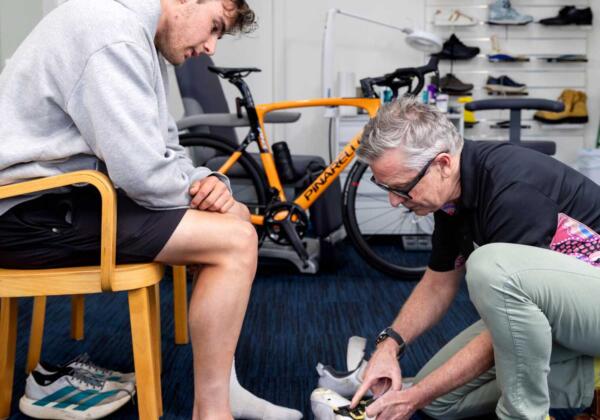
  1. Go straight to the experts at a running specialty store. Plan on spending some time there because the salesperson should ask you lots of questions and have several running shoe options for you to try out.
  2. Make sure the salesperson looks at the shape and arch to figure out what type of foot (high arches or flat feet, for example) you have. Determining your foot type is key to making sure you get the right running shoes. The salesperson should also measure your foot. Your running shoes should be 1/2 to a full size bigger than your regular shoe size because your feet will swell when you run and you need plenty of room in the toebox. If your toes are crammed in the front of the running shoe, you could develop blisters or black toenails.
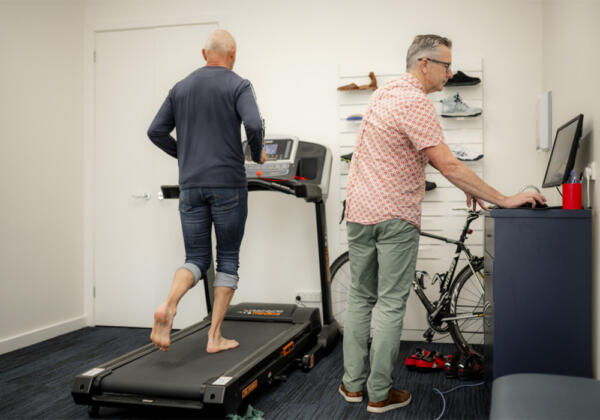
  3. Have the salesperson do a running analysis for you. He’ll watch you run in the running shoes, either outside or on treadmill, and determine your running style. He’ll observe whether you’re overpronating (your foot rolls inward) or supinating (your foot rolls outward) when your foot strikes the ground.
  4. Give the salesperson information that will help him with his running shoe recommendations. He should be asking you questions about what type of running you do, how often you run, where you typically run, if you’re training for a race, and what type of surfaces you run on.
  5. Run in the running shoes that the salesperson recommends for you. (Make sure you’re dressed to run when you’re shopping!) Simply trying on the shoes and walking a few steps inside the store is not enough. Run in each pair of shoes to test for fit, function, and comfort before making your final decision.
  6. Test your running shoes by running in them for a week. If you quickly develop blisters or foot pain, they may not be the right shoes for you. Many specialty running stores have liberal exchange policies and allow you to return running shoes even if you’ve been running in them for a week or more. Take them back and exchange them for another recommended pair of running shoes.

7. After you’ve found your perfect running shoes, you don’t have to keep going back to the specialty running shop. You’ll need to replace your shoes every 300-400 miles.


WARNING : This information is for educational purposes only and is not intended to replace professional podiatric advice. Treatment will vary between individuals depending upon your diagnosis and presenting complaint. An accurate diagnosis can only be made following personal consultation with a Podiatrist.  

Back to Top

Why barefoot runners have the edge on shoe-wearing rivals

Article written by Evan Hobbs – Tuesday 18th May 2010

Your foot is a marvel of 26 bones, 33 joints, 3 arches, and over a hundred muscles, tendons, and ligaments. For millions of years humans went their entire lives barefoot. Runners competed in marathons and even broke the 4-minute mile barrier wearing only leather slippers.

And then sometime at the end of the 1960s the modern running shoe was invented and suddenly our foot became deficient and could not function without arch support and heel cushioning. How did this happen?


Normal feet vs. Shoed feet

The first point is that, though shoes are great for protecting us against rocks, broken glass, and other dangers, they substantially alter the way our feet operate.

Have you ever seen the foot of someone who has never worn shoes? Most people haven’t. Check out these pictures from a 1905 study in the American Journal of Orthopedic Surgery of native populations in the Philippines and Central Africa. The first images show the feet of a person who has never worn shoes. Note the wide forefoot with well separated toes and metatarsals providing a stable base for walking.

The next image shows a European foot for comparison. The foot’s shape has altered drastically in order to conform to the shape of the shoe. The base of the foot is narrow and the toes have little space between them.

Incidentally, the afflictions of the foot that are so prevalent in modern societies (hammertoe, bunions, plantar fasciitis, neuromas, etc.) are largely unheard of in populations that habitually walk barefoot.

Barefoot gait vs. Shoed gait?

Now take out your running shoes and take a look at them. Note how the heel is built up in the back raising the heel of the foot several centimeters above the forefoot.

This particular invention can be traced to Bill Bowerman, one of the founders of Nike and the man who invented the term jogging, in the 1960s. He himself was not much of runner but he reasoned that a thick bit of rubber underneath the heel would force the runner to land on their heel, shift their weight forward, and improve efficiency.

This is a very important point. The natural human running gait is not to land on the heel when running but rather on the mid-to-forefoot. Prove this to yourself by running down the street barefoot landing on your heels—you won’t get far before the pain stops you.

Before Bowerman’s invention, runners ran in thin-soled slippers with no difference in elevation between the heel and forefoot and little cushioning. Now the modern running shoe has become so ubiquitous that most people assume that landing on the heel must be the natural way of running.

But surely running shoes have lessened injuries?

All this would fine if there was evidence that these new shoes resulted in fewer injuries. And yet, running injuries are still common and possibly becoming more common. Every year runners—elite athletes and weekend warriors alike—suffer from plantar fasciitis, stress fractures, knee and back pain, etc. Running is actually a very dangerous sport in terms of per capita injuries.

A 2008 review of literature in the British Journal Sports Medicine looked for any evidence that the prescription of elevated cushioned heels and pronation control resulted in fewer injuries. The review was not able to identify a single study. The lead author of the review, Dr. Craig Richards, was shocked. He issued the following challenge:
“Is any running-shoe company prepared to claim that wearing their distance running shoes will decrease your risk of suffering musculoskeletal running injuries? Is any shoe manufacturer prepared to claim that wearing their running shoes will improve your distance running performance? If you are prepared to make these claims, where is your peer-reviewed data to back it up?” As of yet, none of the major manufacturers have taken up the challenge.

Other studies have shown a connection between injury rates and running shoes, but perhaps not the one that shoe makers would like to highlight. For instance multiple studies have suggested that runners wearing the most expensive shoes are significantly more likely to be injured than runners wearing cheap shoes.

How could this be? 

All this seems somewhat counter-intuitive. Surely adding cushioning and support could only lessen the impact on the joints? In fact the opposite may be true. Your feet rival your hands and face for the amount of nerve endings they contain. They are finely equipped to register the slightest variations in the ground surface below and relay the signals to the central nervous system prompting constant and precise changes in the muscles controlling the foot, ankle, knee, hips, back, and torso. As such the foot needs to feel the ground to determine how to react and may in fact land harder when wearing a cushioned shoe.

Tests of gymnasts have shown that the softer the landing mat, the harder the gymnasts land as their body is searching for a stable landing platform. The same may be true of runners.


Shoes weaken feet 

A supportive running shoe acts a bit like a cast or a crutch. The foot is encased in a protective environment where it is not allowed to move naturally, i.e. motion control shoes which are so expensive. The arch, which under normal circumstances is designed help absorb the impact of landing, is supported and thus weakens over time. The effect is similar to a joint that has been immobilized following an injury and when the immobilization is removed there is typically a substantial loss in muscle tone.

But wouldn’t barefoot running cause more stress on the joints? 

This is a common and understandable thought but after adapting to running barefoot my perception is that running barefoot feels softer and less jarring than running with shoes rather than the opposite.

And a recent Harvard University study published in the prestigious journal Nature supports this idea. Runners who habitually ran with shoes and ones that habitually ran barefoot were asked to run across a force plate which would register the force of their impact upon landing.

The study found that shoed runners landed with a greater impact whereas barefoot runners absorbed the impact more gradually. If you examine the graph on the left you can see the force curve for the shoed runner is steep. On the right the force curve is more gradual as the runner more gently absorbs the impact of landing.


Postural Effects of Shoes 

Looking at the postural effects of shoes with heels (i.e. most shoes including modern running shoes) we can see another way they can lead to lower back, hip and knee pain.

The figure on the left represents a woman standing barefoot and erect. In the middle, the woman’s heels have been elevated. If she maintained this same posture she would fall forward. And on the right, the woman has compensated to avoid falling over by excessively curving her spine (lordosis of the lower back), tilting her hips forward and down, and bending her knees slightly. Additionally, the Achilles tendon is shortened in this position.
This unnatural posture is a big part about of why wearing high heels excessively can lead to problems. And yet precisely the same dynamic exists in the design on the modern running shoe.


My own story

I came to barefoot running after exhausting traditional medical treatments. By age 27, my feet were killing me. I had Morton’s neuromas in both feet that made it seem as if I was walking on marbles; unexplained heel pain; and recurring plantar fasciitis. Walking had become painful and unpleasant. I went the normal route seeing specialists, receiving orthotics from multiple different podiatrists, buying expensive running shoes with video gait analysis, cortisone shots, etc. Nothing helped.

Then I stumbled upon information that suggested that the sophisticated, expensive running shoes might actually be the problem and not the solution. I implemented more and more barefoot activities into my life. Though it was painful at first it seemed to help. It was a slow process and I might have given up if I had not been thoroughly convinced of the logic behind it.

Now a couple years later I can report that my problems have almost completely cleared up. The only time I experience pain is if I push too far (like try to run a couple hours barefoot) and then it’s not serious and only requires that I back off a little bit.

Conclusion

It must be stressed that as of yet there is not enough proof to say for certain that running barefoot is better or will result in fewer injuries.

But consider that for a second. The production of running shoes has turned into a multibillion dollar industry creating ever more complicated and expensive shoes with roll ball bars, thrust enhancers, microchips, etc. and yet no one can show that these running shoes actually reduce injuries and there is some evidence that they may actually cause injuries.

It’s as if someone designed a drug and then set about trying to make better and more expensive versions of it and never stopped to ask the question if we should be taking it in the first place.
Thankfully, in the past years there has been a surge of interest in using our feet as nature intended. Barefoot.

Starting out with barefoot running

A few points if you are intrigued about barefoot:

1. Start slow

If you have been wearing shoes for all your life (which most of us have) realize that your feet are going to be weak and inflexible. You are going to need time to rebuild the natural strength and flexibility in your feet, ankles, and calves. Going out your first day and trying to run several kilometers barefoot could lead to injury.

2. Don’t see it as all or nothing proposition.

Not everyone wants to look like a weirdo running around barefoot. You can still incorporate some of the benefits of barefoot without going all out. Try to spend as much of your time barefoot as possible by taking off your shoes whenever you’re in your house or at the park.

Also, when buying shoes look for ones without an elevated heel or arch support and a wide toebox allowing your feet to move as naturally as possible when walking.

3. Check out Vibrams or other minimalist footwear.

I don’t personally run fully barefoot. I use Vibram Fivefingers shoes which mimic the feeling of running barefoot while still providing a measure of protection from rocks and glass. Currently they can be quite hard to find but a range of new styles are slated to hit the market here in New Zealand towards the end of May 2010.
Ironically, Nike, the company that invented and popularized modern running shoes, has now gotten into the game of providing minimalist footwear with the Nike Free. This is a step in the right direction (no pun intended) but I don’t recommend them since they still have an elevated heel.

If you have questions or want help experimenting with barefooting let me know! I’m happy to share information and tips. You can contact me at evan@corefitnesswellington.co.nz or check out my website: www.corefitnesswellington.co.nz

Back to Top

Achilles Tendinopathy

 What is it?

Achilles Tendinopathy is a painful and often debilitating condition caused by over stressing the Achilles tendon. The injury may occur at the point where the tendon attaches to the heel or at any point along the length of the tendon. Symptoms of Achilles tendinopathy may include pain and tenderness in the affected area, along with decreased strength and movement in the lower leg, swelling and redness. Achilles tendinopathy is caused by overuse and is most often seen in people who have engaged in a sudden increase in activity.

The Achilles tendon is an extension of the two calf muscles; it runs down the back of the lower leg and attaches to the heel bone. The Achilles tendon connects the strong leg muscles to the foot and gives us the ability to rise up on our toes, facilitating walking and running. The Achilles tendon has a poor blood supply so it can be slow to heal.

Because the arch of the foot flattens over time, especially in athletes, someone may be problem-free for years and develop Achilles problems later in life. In these people, the muscles and tendon have little flexibility because of inactivity. It is especially important for people who are just starting to exercise to stretch properly, start slowly, and increase gradually. Correct technique is also essential to minimise overload. Achilles tendinosis weakens the tendon and may make the tendon more vulnerable to tear or rupture. The risk for re-rupture increases if the condition is not treated. It can require weeks to months of rest and appropriate structural control for the tendon to slowly repair itself. If you look after this injury early enough you should make a good recovery. It is important you rehabilitate the tendon properly after it has recovered or the injury will return. If you ignore the early warning signs and do not look after this injury then it may become chronic which is very difficult to treat.

How can it be treated?

Treatment involves initial rest and inflammatory control.

Seek professional podiatrist treatment for:

  • Strapping to support and unload the stressed area.
  • Resolution of muscular inflexibility through massage and specific exercises.
  • Ultrasound to improve blood flow and healing.
  • Control of improper foot mechanics

WARNING : This information is for educational purposes only and is not intended to replace professional podiatric advice. Treatment will vary between individuals depending upon your diagnosis and presenting complaint. An accurate diagnosis can only be made following personal consultation with a Podiatrist.  

Back to Top

Sports – Calf Strain

Calf  Strain


The calf muscles consist of the Gastrocnemius, which is the big muscle at the back of the lower leg, and the Soleus muscle, which is a smaller muscle lower down in the leg and under the Gastrocnemius. Either of these two muscles can be strained (torn). Gastrocnemius-soleus strains are commonly seen in explosive sports such as court sports involving quick moves in all directions and often involve predisposition due to poor leg and foot structure.

Symptoms

Symptoms include sudden pain at the back of the leg with difficulty in contracting the muscle or standing on toes. Pain, swelling &/or bruising in the calf muscle may also occur. Most commonly injury will occur at the muscle-tendon junction.

Treatment

Involves implementation of rest, ice, compression, & elevation (RICE) for the acute phase. Followed by professional podiatric bracing, massage, rehabilitative stretching and strengthening exercises and control of any predisposing structural anomalies of the leg and foot.

WARNING : This information is for educational purposes only and is not intended to replace professional podiatric advice. Treatment will vary between individuals depending upon your diagnosis and presenting complaint. An accurate diagnosis can only be made following personal consultation with a Podiatrist.

Back to Top